RESEARCH
Can be used in research studies and clinical trials to study different surgical approaches.

FACE-Q Paralysis is a rigorously developed patient-reported outcome measure that can be used to collect and compare evidence-based outcomes data from children and adults with congenital or acquired facial paralysis. This FACE-Q module was developed from concept elicitation interviews with 11 children and 14 adults with facial nerve paralysis. The qualitative study was followed by an international field-test study that recruited a total of 235 children and adults with this condition.

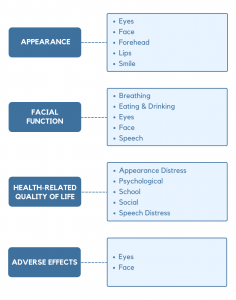
The conceptual framework for FACE-Q Paralysis covers 4 domains: appearance, function, health-related quality of life, and adverse effects. Each domain is composed of multiple independently functioning scales/checklists. The variety of scales/checklists provides flexibility to choose the subset best suited to measure the outcomes of interest in any given study or clinical situation.
Can be used in research studies and clinical trials to study different surgical approaches.
Carefully designed to meet the requirements of regulatory bodies.
Included in ICHOM Standard Sets for facial paralysis to enable hospitals around the world to compare outcomes.
Designed using a modern psychometric approach to facilitate use in patient care.
The FACE-Q Paralysis module includes a subset of scales/checklist from the FACE-Q Craniofacial module relevant to facial paralysis. These scales measure appearance (eyes, face, forehead, lips, smile), function (breathing, eating, eyes, face, speech), health-related quality of life (appearance distress, psychological, social, school, speech distress), and adverse effects (eyes, face). Clinicians and researchers are able to administer the subset of scales relevant to their situation.
Five scales measure aspects of appearance that can be affected by facial paralysis. One scale measures face overall, and the other scales measure the eyes, forehead, lips, and smile.
Five scales/checklists measure facial functions, including breathing, eating/drinking, functions involving the eye (e.g., blink, see properly) and face (e.g., smile, frown), as well as speaking.
Five scales measure aspects of health-related quality of life, including appearance-related distress, speech distress, as well as psychological, social, and school function.
Two checklists measure adverse effects associated with the eyes and face overall (e.g., itchy, sore, dry, numb, swollen).