
CONCEPT-DRIVEN APPROACH
The LABIA-Q was developed from 12 concept elicitation interviews with women who had received a female genital intervention. To further establish content validity, 7 cognitive interviews were performed, and input was obtained from 11 clinical experts. The LABIA-Q was field-tested in a sample of 339 women.

MODULAR DESIGN
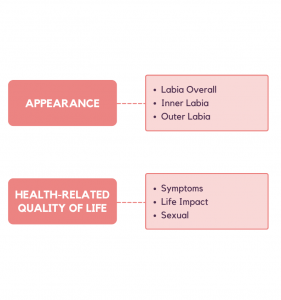
The LABIA-Q includes 6 independently functioning scales that measure appearance (overall, inner, outer labia), life impact, sexual well-being and labia symptoms. The scales provide flexibility to choose the subset best suited to measure the outcomes of interest in any given study or clinical situation.
Scale Structure
Labial interventions, both surgical and nonsurgical, have expanded over the past decade. LABIA-Q is a newly developed patient-reported outcome measure that can be used to evaluate outcomes important to women. This instrument measures 2 main domains, i.e., appearance and health-related quality of life. Each domain includes 3 scales. Clinicians and researchers are able to administer a subset of scales relevant to their situation.
LABIA APPEARANCE OVERALL
This 7-item scale measures labia appearance. Items ask about how underwear fit, how noticeable the labia are in snug clothes, etc.
INNER LABIA APPEARANCE
This 11-item scale includes items for labia appearance overall and items specific to the inner labia, such as their size, how much they hang when standing, etc.
OUTER LABIA APPEARANCE
This 11-item scale includes items for labia appearance overall and items specific to the outer labia, such as their size, how far they come out (bulge), etc.
LIFE IMPACT
This 10-item scale measures the impact of labia on quality of life. Items ask how much one’s labia negatively interferes with being active, sexual life, body image, etc.
SEXUAL WELL-BEING
This 9-item scale measures the impact of labia on sexual well-being. Items ask how often women feel good about their sex life, feel confident sexually, etc.
LABIA SYMPTOMS
This 8-item scale measures frequency of experiencing symptoms in the past week. Items ask about feeling sore, discomfort when sitting and walking, etc.
LABIA-Q FRAMEWORK
CO-DEVELOPERS

Dr Anne Klassen
McMaster University, CA
Q-Portfolio
Dr Heather Furnas
Stanford University, US
Q-Portfolio
Dr Manraj Kaur
Brigham and Women’s Hospital, US
Q-Portfolio
Setting the Bar in
Patient Reported
Outcome Measurement
Funding Provided By: